




Corrugated box
Corrugated Box
"Corrugated boxes," commonly seen as cardboard with wavy folds in the middle, are not just limited to use as shipping containers. From protective functionality to design aesthetics, there's a lot more to them than meets the eye.
🤔 The "Hidden Identity" of Corrugated Boxes
You might only know it's used for shipping, but corrugated boxes have long since moved beyond their original purpose, transforming into various elegant product packaging solutions.
From transportation to "frontage": Traditionally, corrugated boxes have been used for logistics, replacing wooden crates with lightweight and eco-friendly alternatives. Now, brands are beginning to use them as product packaging, enhancing the product's quality and premium feel through elegant designs and specialty papers.
Structural Innovation: Beyond the common delivery boxes, corrugated boxes have evolved into various forms such as airplane boxes, top-bottom lids, and flip-top boxes. Some designs can even slowly rise like gifts or quickly take shape with a simple press—highly creative solutions.
Inner lining favorite: Corrugated cardboard offers excellent cushioning and is now commonly used as a substitute for foam plastic in packaging, providing both environmental benefits and superior protection.
📝 How to Choose the Right Corrugated Box?
To choose the right corrugated box, it's essential to understand these key parameters—no more struggling with tables.
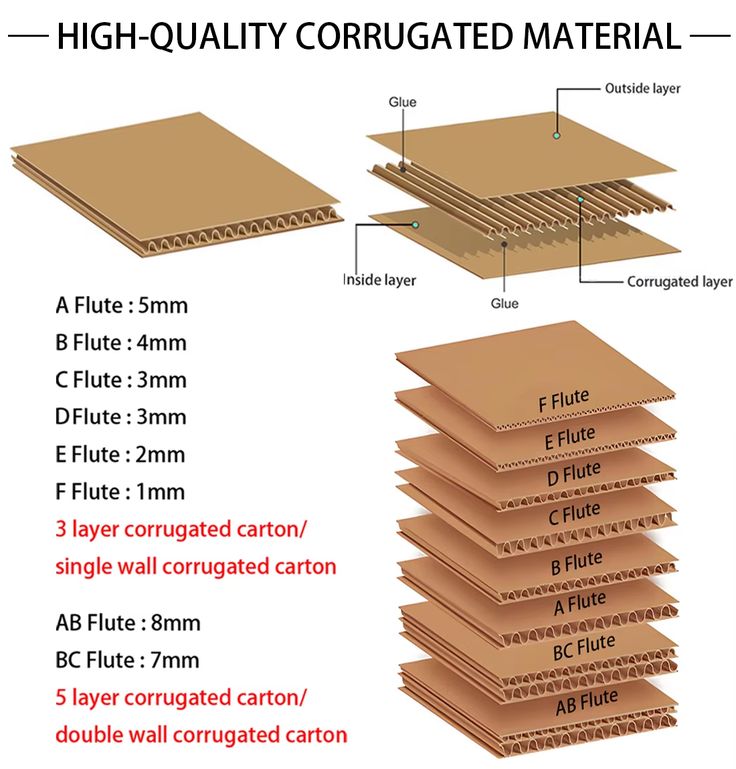
Look at the "wave" (corrugation): The shape of the corrugated pattern determines the box's rigidity and cushioning properties.
A-flute: The highest wave pattern, offering the best cushioning and shock absorption, ideal for packaging fragile items such as glass and ceramics.
B-flute: Features shorter waves, a smooth surface, and strong compression resistance, making it suitable for use in canned food boxes and similar applications.
C-flute: Performance between A and B, with good overall performance, commonly used in shipping packaging.
E-flute / F-flute: Extremely thin corrugation with high surface flatness, ideal for fine printing, commonly used in premium packaging such as cosmetics and electronics.
.png)
Look at the "number of floors": common ones include three, five, and seven stories.
Three-ply: Composed of face paper, corrugated paper, and liner paper, suitable for lightweight packaging.
Five-layer: Typically double corrugated, such as BC flute, offering better strength and cushioning, suitable for medium-sized packaging.
Look at the "skin" (cover paper): The paper on the box's surface determines its appearance and printing quality.
Kraft paper: High strength and excellent tear resistance, ideal for packaging heavy items—very durable.
White cardstock: smooth surface, excellent print quality, ideal for packaging with high aesthetic standards.
Specialty paper: features unique texture and feel, instantly elevating the quality and sensory experience of packaging.
✨ Advanced Play: Making Corrugated Boxes More Special
If you want to get creative with packaging, try these ideas.
Structural Innovation: It can be designed in a retro envelope style, or incorporate handles and sliding mechanisms to enhance the unboxing experience with a sense of ceremony.
Material Mix-and-Match: Combining different colored straps on corrugated boxes or using various paper materials for lamination can easily create brand differentiation.
Eco-friendly concept: Choosing recycled paper materials or using environmentally friendly, foldable designs that require no glue are currently popular approaches.
📦 Box Selection Quick Memory
For load-bearing and shock resistance: choose A-flute or C-flute for shipping outer packaging.
For high-quality surface printing: choose E-flute or F-flute, paired with white cardboard.
To balance cost and performance: choose B-flute or BC double-flute, which offer strong versatility.